A funded trading account is an account provided by a proprietary trading firm, usually called a prop firm, that you trade under the firm's rules in exchange for a share of the profits you make. Instead of risking your own savings, you pay a fee to prove your skill, and if you meet the firm's conditions you receive a larger account and can request payouts based on your results.
Most funded accounts today are reached through an evaluation, often called a challenge: a trial period in which you must reach a profit target without breaking any risk limit. Some firms also offer instant funding, which skips the evaluation for a higher price.
This guide explains how the model works, what the typical rules look like, what it really costs, and what to check before choosing a firm. If you are new to the markets, read What Is Trading? first.
How a funded trading account works
The path is similar at most firms:
- You choose an account. You pick an account size (for example $10,000, $50,000 or $100,000) and a program type, and pay a one-time fee.
- You trade the evaluation. You trade the account under the program's rules until you reach the profit target, or until a rule ends the attempt.
- You receive the funded account. If you pass, the firm gives you a funded account of the same size. There is usually no profit target any more, but the risk limits still apply.
- You request payouts. Once you meet the firm's payout conditions, you request a withdrawal of your share of the profit. The firm pays it and the account continues.
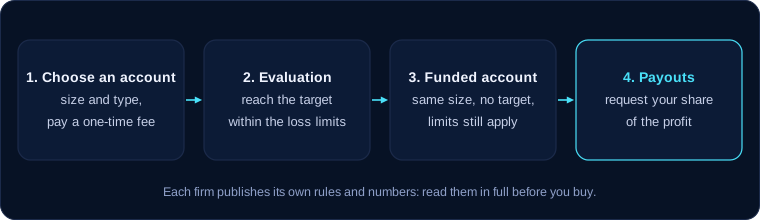
The idea behind the model is simple: the firm is not looking for traders who can make a lot of money in one lucky week. It is looking for traders who can make steady profits while keeping losses under control, because that is the skill that lasts.
One-step, two-step or instant funding
One-step evaluation
You pass a single phase: reach the profit target while respecting the risk limits. It is the fastest route to a funded account.
Two-step evaluation
You pass two phases in a row. The second phase usually has a lower profit target. Two-step programs are often cheaper for the same account size, or come with looser limits, because the firm sees more of your trading before funding you.
Instant funding
You receive a funded account straight away, with no evaluation. It costs more, and the rules on the funded account are often tighter, since the firm has seen nothing of your trading yet.
The rules funded programs typically use
Every firm sets its own rules and its own numbers, so read them in full before you buy. The common categories are:
- Profit target. The gain you must reach to pass an evaluation phase, set as a percentage of the starting balance.
- Daily loss limit. The most the account may lose in a single day. Crossing it ends the attempt.
- Overall drawdown limit. The most the account may lose in total. It is measured either from the starting balance (static) or from the highest balance reached (trailing).
- Minimum trading days. Some programs require you to trade on a minimum number of separate days before you pass.
- Trading restrictions. Many firms restrict certain practices, for example automated trading or trading around major economic releases.
Here is how two of these limits interact, with numbers chosen only for illustration. Suppose a $100,000 program sets an 8% profit target and a 5% overall drawdown limit measured from the starting balance:
- You pass when the balance reaches $108,000.
- The attempt ends if the account ever falls to $95,000.
So you have $8,000 of room on the upside and only $5,000 on the downside. That asymmetry is why risk control matters more than finding winning trades. If you risk $1,000 per trade, five losses in a row are enough to end the attempt. At $250 per trade, it takes twenty. Our guide on how to measure risk shows how to plan for losing streaks like these.
Are funded accounts real money?
Usually not, and a good firm says so plainly. Most funded programs run on simulated accounts: your orders are filled at live market prices, but they are not sent to a real exchange or market. The profits you make are calculated from that simulated trading, and the firm pays your share as a payout from its own funds.
For you as a trader, this changes less than it sounds. The prices are real, the discipline required is the same, and the payout is real money. What it does mean is that you never own the assets you trade through the account, and the firm's payout terms and reliability matter as much as the account itself.
What a funded account costs
The main cost is the evaluation fee, paid once per attempt. If a rule ends the attempt, the fee is not returned; you can buy a new evaluation if you want to try again.
Two points are worth understanding:
- Your loss is capped at the fee. On a simulated funded account you do not deposit trading capital, so a bad trade cannot cost you more than what you paid for the program.
- The fee is the price of the attempt, not a deposit. Treat it as money you are prepared to lose, and never pay it with money you cannot afford to lose or with borrowed money.
Some firms also sell optional extras, such as a different platform or a different profit share. Read what each one includes before adding it.
Funded account vs trading your own money
| Funded account | Your own account | |
|---|---|---|
| Money you put at risk | The evaluation fee | Your whole deposit |
| Account size | Can be much larger than your savings | Limited to what you deposit |
| Rules | Firm's loss limits and restrictions | Only the broker's margin rules |
| Profit | A share, paid as payouts | All of it is yours |
| Pressure | Hard limits can end the account | No external limits, which also means no safety net |
Neither is better for everyone. A funded account suits traders who want a larger account than their savings allow and who already trade with a fixed risk per trade. Your own account suits traders who want full freedom and are trading small amounts while they learn.
How to choose a prop firm
Before paying any firm, check:
- Published rules. Every limit should be written down in full, with clear numbers and examples. Vague rules are a warning sign.
- Payout record. Look for evidence that payouts are actually made, and read the payout conditions: when you can request one, how it is paid, and how long it takes.
- Identity verification. Serious firms verify your identity before paying you. That protects traders as much as the firm.
- Support. Send a question before you buy and see how fast, and how clearly, you get an answer.
- Platforms and markets. Make sure the firm offers the instruments and the platform you actually trade.
How it works at Drift Fund
Drift Fund offers evaluation challenges and Instant Funded accounts from $10,000 to $300,000. You can choose a Spot account (crypto at spot prices, no leverage, long only) or a Futures account (long and short with leverage, covering crypto, major forex pairs, gold and silver). The differences between the two are explained in Forex vs Futures vs Spot.
Every Drift Fund account, challenge and funded, is simulated at live market prices, and payouts are paid by Drift Fund from its own funds as a performance reward based on the results of the funded account. You can trade on the web platform, or on MetaTrader 5 with a Futures account. The full rules for each account type are on the Rules page, and the platform tutorial shows the whole path from your first login to a payout request.
Common mistakes
- Buying the largest account first. A bigger account does not make you a better trader. Start with a size whose fee you are comfortable losing, and move up once you have passed.
- Not reading the rules before the first trade. Most attempts end on a rule the trader did not know. Read every rule before you place a trade.
- Trying to pass in one or two days. Large positions to hit the target quickly are the fastest way to hit a loss limit. Use the same position sizing you would use on any account.
- Treating the evaluation differently from the funded account. Trade the evaluation exactly as you plan to trade once funded. Habits built while rushing tend to stay.
- Buying a new attempt right after losing one. Take a break, review your trades in a trading journal, and come back with a plan.
Key takeaways
- A funded trading account lets you trade a firm's account under its rules in exchange for a share of the profits.
- Most programs start with an evaluation: reach a profit target without breaking a loss limit. Instant funding skips it for a higher price.
- Loss limits leave less room on the downside than the target gives you on the upside, so risk control decides most outcomes.
- Most funded accounts are simulated at live prices; payouts are real and paid by the firm.
- On a simulated funded account the most you can lose is the fee, and that fee should only come from money you can afford to lose.
- Choose a firm with complete published rules, a visible payout record, identity checks and responsive support.
Frequently asked questions
Do I need experience to get a funded account?
No firm can stop a beginner from buying an evaluation, but passing requires consistent risk control, which takes practice. Learn the basics first, especially risk management, and consider starting with a smaller account.
Can I lose more than the evaluation fee?
On a simulated funded account, no. You do not deposit trading capital, so losses on the account cannot be charged to you. The fee itself is not refunded if a rule ends the attempt.
How long does it take to pass an evaluation?
It depends on the program and on you. Some programs have no time limit, others have a deadline or a minimum number of trading days. Trying to pass as fast as possible usually means taking too much risk.
Is a funded trader an employee of the firm?
Generally not. You buy access to a program and receive payouts as a performance reward under its terms. Check the firm's terms to see exactly how payouts and taxes are handled where you live.