Trading psychology is the way your emotions, habits and state of mind shape your decisions in the market. Good trading psychology does not mean feeling nothing; it means following your plan even when fear, greed or frustration pull you the other way.
Many of the costliest mistakes traders make are not analysis errors but execution errors: skipping a valid setup out of fear, doubling your size after a win, moving a stop loss because you cannot accept being wrong, or jumping straight back in to "win it back."
This guide takes the main emotional traps one at a time, shows what they cost on a trade with real-looking numbers, and gives you routines that make discipline easier.
Why discipline matters more than any single trade
A trading plan is a written set of rules for what you trade, when you enter, where your stop and target go, and how much you risk. If you have not written one yet, start with how to build a trading plan and keep a trading journal.
A plan only has value if you follow it consistently. Any approach produces a mix of wins and losses, and its real character only shows over dozens of trades. If you follow the rules on some trades and improvise on others, you can no longer tell whether the plan works.
Fear and greed: two sides of the same problem
Fear: hesitation and cutting winners early
Fear usually shows up after a few losses. A setup meets every rule, but you hesitate, wait for "one more candle," and watch price leave without you. Or you take the trade, it moves your way, and you close it at a small profit because you are afraid of giving it back.
Many approaches rely on a smaller number of larger winners to pay for a series of small losses. If you skip trades and cut winners short but still take every full loss, the math turns against you even when your analysis is sound. The guide to risk-reward ratio and win rate shows why.
The fix is to make each trade feel smaller. Risk an amount you can lose without real discomfort, set your stop and target before you enter, and let the orders do the work.
Greed: oversizing and moving targets
Greed often follows a winning streak. You feel sure of yourself, so you double your position size or move your take profit further away as price approaches it. A target moved mid-trade is rarely based on new analysis; it is usually hope.
Oversizing is the most dangerous form of greed, because one loss at double size can erase several normal wins. Keep your risk per trade the same after wins and after losses, and size every position from your stop distance as shown in how to calculate position size from your stop loss.
Revenge trading and tilt
Revenge trading is taking a quick, unplanned trade, often bigger than usual, to win back money you just lost. It feels like fixing a mistake. In practice it is a trade with no setup behind it, taken when your judgment is weakest.
Here is a worked example with illustrative numbers. Say you have a $10,000 account and risk 1% per trade, which is $100. Three planned trades in a row hit their stops, so you are down $300, or 3%.
- Following the plan: you stop for the day. The loss stays at $300, an ordinary losing streak your risk rules were designed to absorb.
- Revenge trading: you open a fourth trade with no setup and double the risk to $200 to "get it back faster." It loses too. You are now down $500, or 5%, and $200 of that came from a trade your plan never allowed.
Tilt is the state in which frustration or anxiety has taken over your decisions. Signs include clicking faster than usual, skipping your checklist, increasing size and feeling a physical urge to be in a trade. Once you notice them, the right move is to stop, not to try harder.
Overtrading, FOMO and chasing
Overtrading means taking more trades than your plan calls for, often out of boredom or a wish to "make the day count." Each extra trade adds spread costs and exposure without adding any edge.
FOMO, the fear of missing out, is closely related. Suppose, for example, gold jumps from $2,400 to $2,430 in an hour and you buy near the top because you cannot stand watching it run without you. Chasing usually means a poor entry, a stop that is either too tight or too wide for your risk, and a target with little room left.
Set a maximum number of trades per day in your plan and stop when you reach it. And remember that a missed move costs you nothing: a trade you did not take cannot lose money.
Loss aversion and the urge to move your stop
Loss aversion is the tendency to feel a loss more strongly than a gain of the same size. In trading it shows up as a refusal to accept a small, planned loss: you move your stop further away "to give the trade room," hoping price will come back.
A worked example, with illustrative prices: you buy EUR/USD at 1.0850 with a stop at 1.0825, which is 25 pips away (a pip is 0.0001 on EUR/USD). You trade 0.4 lots. One pip on a standard lot of EUR/USD is worth $10, so each pip on 0.4 lots is worth $4, and your planned risk is 25 × $4 = $100. The guide to pips, lots, contract size and leverage explains these units.
Price drops to 1.0830, and you move your stop down to 1.0800. The stop is now 50 pips from entry, so your risk becomes 50 × $4 = $200. If price hits the new stop, you lose twice what you planned on a trade that had already shown your idea was wrong.
A stop loss is a decision you make while you are calm, so that you do not have to make it while you are afraid.
A stop may move in the direction of your trade to protect profit, never against it. If you often feel the need to widen stops, your initial stops may be too tight for the market's normal movement; fix that in your plan between sessions.
Practical routines that make discipline easier
Willpower runs out; routines do not. Before every entry, run a short pre-trade checklist and place the trade only if every answer is yes:
- Does this setup match one written in my plan?
- Is my stop where the trade idea is clearly proven wrong?
- Have I sized the position so the stop risks my fixed amount?
- Am I within my maximum trades and my daily stop for today?
- Am I calm, rested and free of the last trade's result?
Fixed risk per trade. Risk the same small percentage of your account on every trade, for example 0.5% or 1%. When no single trade can hurt much, fear and greed lose most of their grip.
A daily stop as a personal habit. Decide in advance the most you will lose in one day, for example 2R (twice your normal risk) or three losing trades in a row, and close the platform when you reach it. If you trade an evaluation or funded account with a prop firm, keep this personal stop well inside any limit the firm sets.
Breaks and sleep. Step away from the screen after every trade closes, even for five minutes. Tiredness makes everyone more impulsive, so skip trading when you are short on sleep, unwell or upset about something outside the market.
One more point, gently made: trading money you cannot afford to lose, or borrowed money, makes every one of these problems worse, so only trade with money that is genuinely spare.
Process over outcome
A good trade is one that followed your plan, not one that made money. A well-planned trade can lose, and a reckless one can win. If you judge yourself only by results, a lucky win teaches you to break your rules again.
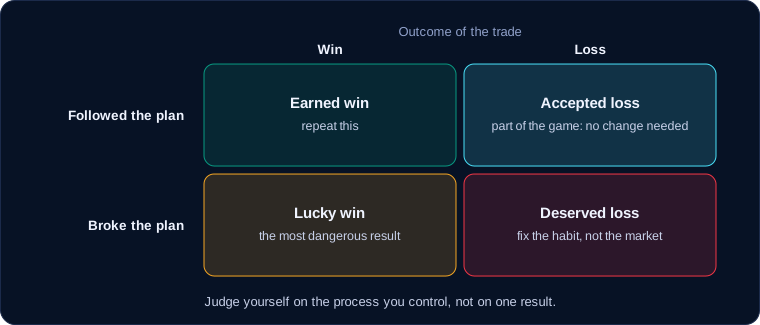
Grade each trade on execution instead: did you take a valid setup, size it correctly, place the stop and target by your rules, and leave them alone? Record the answer in your journal next to the result. That part is fully under your control.
Common mistakes
- Raising size to recover losses. Fix: keep risk per trade fixed, and consider cutting it, for example by half, after a losing streak.
- Moving a stop loss further away. Fix: let stops move only in the direction of your trade, and adjust your stop rules in the plan if they are too tight.
- Trading through tilt. Fix: set a personal daily stop and close the platform the moment you hit it.
- Judging a trade by its result. Fix: grade each trade on whether you followed your plan, and review those grades weekly.
Key takeaways
- Trading psychology is about following your plan when emotions push you away from it.
- Fear shows up as hesitation and cutting winners early; greed as oversizing and moving targets.
- Revenge trading and widening your stop both turn a planned loss into a larger, unplanned one.
- A checklist, fixed risk per trade, a personal daily stop, breaks and sleep make discipline easier.
- Judge yourself on process, not on the result of any single trade.
Frequently asked questions
How do I stop revenge trading?
Decide your daily stop before the session starts and close the platform when you hit it. Add a rule that you step away for at least 15 minutes after any loss. Revenge trading depends on speed, so anything that slows you down helps.
Why do I close winning trades too early?
Usually because the amount at risk feels too large, or because recent losses have made you anxious to lock in anything. Reduce your risk per trade until a full loss feels acceptable, set your take profit before entry, and log every early exit so you can see what the habit costs.
Is trading psychology more important than strategy?
You need both. Discipline cannot rescue a method that has no edge, and a sound method will not work if you do not follow it. Psychology is what lets you execute the same way every time, so you can see your strategy's real results.