An order type tells your trading platform how and when to execute a trade. A market order fills immediately at the best available price, a limit order fills only at your price or better, and a stop order waits until price reaches a level and then becomes a market order.
Almost every other order is built from those three. A stop loss is a stop order that closes a position, a take profit is a limit order that closes one, and a trailing stop is a stop loss that moves with price. Knowing how each one fills tells you what can go wrong: a limit may never fill, and a stop can fill worse than its level.
Market orders: fill now at the available price
A buy market order fills at the ask, the price sellers are offering, and a sell fills at the bid, the price buyers are paying. The gap between them is the spread, explained in bid, ask and spread.
For example, if EUR/USD is quoted at 1.0849 bid and 1.0850 ask, a market buy fills at about 1.0850 and a market sell at about 1.0849. In a fast market the price can change between your click and the fill, and that difference is called slippage. A market order gives you certainty of a fill, not of price.
Pending entry orders: limit and stop
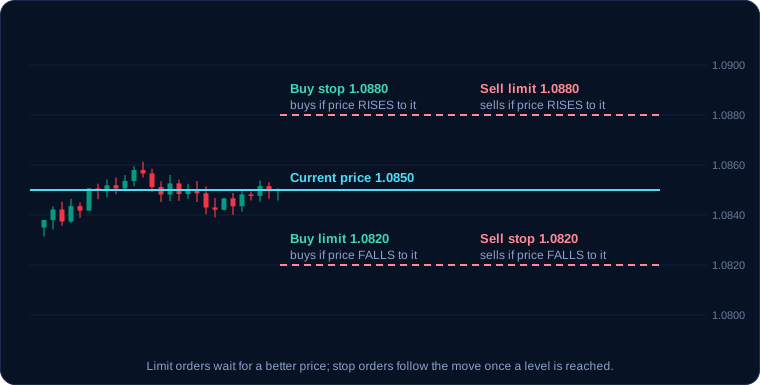
A pending order waits for price to reach a level you choose. Limits and stops differ in which side of the current price they sit on.
Buy limit and sell limit
A limit order fills at your price or better. A buy limit sits below the current price and a sell limit above it.
For example, gold (XAU/USD) trades at $2,400 and you want to buy only on a pullback to $2,385, so you place a buy limit there. If price falls to $2,385, the order fills at that price or lower. If price turns at $2,386 and rallies, it never fills. You control the price but not whether you get a fill.
Buy stop and sell stop
A buy stop sits above the current price and a sell stop below it. Traders use them to enter on a breakout, when price pushes through a level.
When a stop is triggered, it becomes a market order, so in a fast or gapping market it can fill worse than its level. For example, with EUR/USD at 1.0850 you place a buy stop at 1.0880, just above resistance. A sharp move triggers it at 1.0880, but the fill comes at 1.0882, 2 pips worse than planned.
Stop-limit
A stop-limit order has two prices: a stop price that triggers it and a limit price for the order it creates. Once triggered, it becomes a limit order, so it fills only at the limit price or better, and it may not fill at all.
For example, with BTC/USD at $65,000 you place a buy stop-limit with a stop at $66,000 and a limit at $66,150. If price reaches $66,000, a buy limit becomes active and can fill at any price up to $66,150. If price jumps past $66,150 first, you get no position, which can be better than a bad fill.
Platforms set the two prices differently: in MetaTrader 5 (MT5), a Buy Stop Limit places its buy limit below the stop level, waiting for a pullback after the breakout. Check your platform's definition first.
Entry orders at a glance
| Order | Placed | Fills at | Main risk |
|---|---|---|---|
| Market | Now | Best available price | Slippage in fast markets |
| Buy limit | Below current price | Limit price or better | May not fill |
| Sell limit | Above current price | Limit price or better | May not fill |
| Buy stop | Above current price | Market price once triggered | Can fill worse than the stop |
| Sell stop | Below current price | Market price once triggered | Can fill worse than the stop |
| Stop-limit | Stop trigger plus a limit | Limit price or better once triggered | May not fill at all |
Exit orders: stop loss and take profit
A stop loss closes your position if price moves against you to a set level. A take profit closes it when price reaches your target.
For example, you buy 1 lot of EUR/USD at 1.0850 with a stop loss at 1.0825 and a take profit at 1.0900. At $10 per pip on a standard lot, the 25-pip stop means a planned loss of 25 × $10 = $250, and the 50-pip target a planned gain of 50 × $10 = $500.
A take profit is a limit order, so it fills at your target or better. A stop loss is a stop order, so it becomes a market order when triggered and can fill worse than its level.
Gaps and slippage on stop losses
A stop loss limits your loss in normal conditions, but it does not fix the exit price. Forex and gold markets close at the weekend, and price can open on Monday far from Friday's close. Crypto trades seven days a week but can still jump sharply on news.
For example, you hold 0.5 lots of gold (100 oz per lot) bought at $2,400 with a stop at $2,385. Gold closes on Friday at $2,392 and opens on Monday at $2,378. Your stop triggers at the open and fills around $2,378, $7 below the stop.
- Planned loss: 0.5 × 100 × (2,400 − 2,385) = $750
- Actual loss: 0.5 × 100 × (2,400 − 2,378) = $1,100
Which price triggers your stop
On most platforms, including MT5, a buy position closes by selling, so its stop loss and take profit trigger on the bid. A sell position closes by buying, so its orders trigger on the ask. Charts usually show the bid, so a short position's stop can be hit even though the chart line never touched it: the ask sits a spread above.
Trailing stops and OCO orders
Trailing stop
A trailing stop follows price at a fixed distance as the trade moves in your favor and never moves back.
For example, you buy BTC at $65,000 with a $1,500 trailing stop, so the stop starts at $63,500. Price rises to $68,000 and the stop follows to $66,500. When price falls back, the stop triggers at about $66,500, locking in roughly $1,500 per BTC before slippage.
A distance that is too tight gets hit by ordinary pullbacks. In MT5, the built-in trailing stop runs inside your terminal, so it only moves while MT5 is open and connected; the last level it set stays in place on the server.
OCO: one cancels the other
An OCO (one-cancels-the-other) links two orders so that when one fills, the other is cancelled. The stop loss and take profit on an open position already behave this way.
Traders also use OCO for breakout entries. For example, if gold is ranging between $2,390 and $2,410, a buy stop at $2,412 and a sell stop at $2,388 can be linked so that whichever triggers first cancels the other. Where your platform has no OCO order type, you cancel the unused order yourself.
Where to place a stop loss
A stop belongs at the price where your trade idea is proven wrong, not at a round amount of money.
- Go beyond structure. For a buy, place the stop below the recent swing low or support; for a sell, above the swing high or resistance. See support and resistance.
- Add a buffer. Price often probes just past obvious levels, so leave a few pips or dollars of room.
- Account for the spread. A sell position's stop triggers on the ask, so add the spread to a stop placed above a high.
- Then size the trade. Choose a size that keeps the loss at that stop within your plan, as shown in position sizing.
For example, you buy EUR/USD at 1.0850 and the last swing low is 1.0832. A stop 3 pips below it, at 1.0829, gives a 21-pip stop distance. For a sell at 1.0850 under a swing high of 1.0868, with a 1-pip spread, a stop at 1.0871 covers the spread plus a 2-pip buffer.
Common mistakes
- Mixing up limit and stop. A buy limit sits below the market and a buy stop above it. Limit means a better price; stop means a breakout or an exit.
- Stops inside the noise. A stop a few pips from entry gets hit by normal fluctuation. Place it beyond structure and trade a smaller size instead.
- Moving a stop further away as price approaches. This turns a planned loss into a bigger, unplanned one. Move a stop only to reduce risk.
- Treating a stop loss as an exact exit price. Gaps and fast markets can fill you worse, so keep sizes small enough that some slippage is survivable.
Key takeaways
- Market orders give you a fill but not a set price; limit orders give you your price or better but may not fill.
- A stop order becomes a market order when triggered, so it can fill worse than its level in fast or gapping markets.
- A stop loss is a stop order and a take profit is a limit order; together they behave like an OCO pair.
- Buy positions close on the bid and sell positions on the ask, so allow for the spread when placing stops.
- Place stops where the trade idea fails, beyond structure, then size the position from that distance.
Frequently asked questions
What is the difference between a stop order and a limit order?
A limit order fills at your price or better, so you use it to buy below or sell above the current price. A stop order triggers when price moves through your level and then fills as a market order. Limits control price; stops get you in or out once a level breaks.
Does a stop loss guarantee my exit price?
No. A standard stop loss becomes a market order when triggered, so in a fast market or a gap it can fill worse than the level you set. It still caps your loss in normal conditions.
What is a trailing stop loss?
A trailing stop is a stop loss that follows price by a set distance as the trade moves in your favor and stays put when price moves against you. In MT5, it only updates while your terminal is running.