Forex trades 24 hours a day, five days a week, from Sunday evening to Friday evening, New York time, passing through four main sessions: Sydney, Tokyo, London and New York. Gold follows roughly the same weekly schedule, while crypto trades 24 hours a day, seven days a week, including weekends and holidays.
Knowing when a market is busiest matters more than it first seems. Liquidity, spreads and the size of typical moves all change through the day, so the same strategy can behave very differently at 03:00 UTC and at 14:00 UTC.
This guide sets out the sessions and overlaps in UTC, daylight saving shifts, weekend gaps and how each session tends to behave.
Forex: a 24-hour market, five days a week
Forex has no central exchange, so there is no single opening bell. Trading follows the business day around the world: as banks in one financial center wind down, the next center starts, so activity passes from Sydney to Tokyo to London to New York.
The forex week opens on Sunday at around 5 pm New York time and closes on Friday at around 5 pm New York time. In UTC, that is roughly 22:00 Sunday to 22:00 Friday while New York is on standard time (winter), and 21:00 to 21:00 while it is on daylight saving time (summer). Your platform may open a few minutes later or close a little earlier.
Session times in UTC
Session times are conventions rather than official hours, and sources vary by about an hour. The table uses common local business hours.
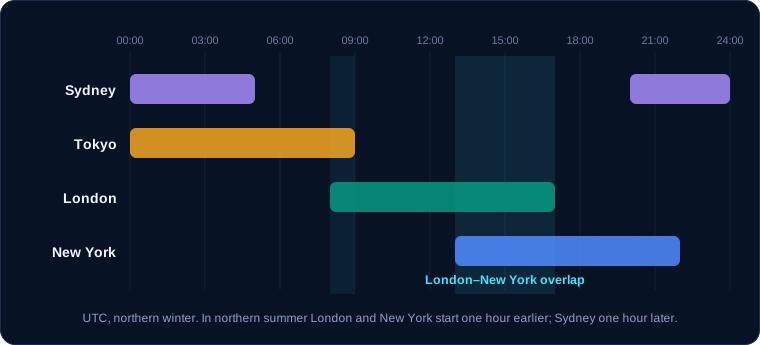
| Session | Local hours | UTC, northern winter | UTC, northern summer | Most active pairs |
|---|---|---|---|---|
| Sydney | 07:00–16:00 | 20:00–05:00 | 21:00–06:00 | AUD and NZD pairs |
| Tokyo | 09:00–18:00 | 00:00–09:00 | 00:00–09:00 | JPY, AUD and NZD pairs |
| London | 08:00–17:00 | 08:00–17:00 | 07:00–16:00 | EUR, GBP and CHF pairs |
| New York | 08:00–17:00 | 13:00–22:00 | 12:00–21:00 | USD pairs and USD/CAD |
Daylight saving shifts
Several clock changes move these times through the year:
- The UK and the US move their clocks forward in spring and back in autumn, so London and New York start one hour earlier in UTC during the northern summer.
- The US and Europe change clocks on different dates, so for two to three weeks in March, and about a week around the end of October, London and New York are four hours apart instead of five.
- Australia's daylight saving runs from early October to early April, the opposite half of the year, so Sydney starts earlier in UTC during the northern winter.
- Japan does not use daylight saving, so Tokyo stays at 00:00–09:00 UTC all year.
Worked example: converting sessions to your time
For example, say your clock is fixed at UTC+4 and your country does not use daylight saving.
- London open, northern winter: 08:00 UTC + 4 hours = 12:00 your time
- London open, northern summer: 07:00 UTC + 4 hours = 11:00 your time
- New York open, northern winter: 13:00 UTC + 4 hours = 17:00 your time
- New York open, northern summer: 12:00 UTC + 4 hours = 16:00 your time
If your country does use daylight saving, adjust for your own clock change too, and recheck your times after each change in March, April, October and November.
Session overlaps and liquidity
Liquidity, meaning how many buy and sell orders sit near the current price, is highest when two major centers are open at once.
- London and New York: 13:00–17:00 UTC in northern winter and 12:00–16:00 UTC in summer. This is generally the most liquid window of the forex day, with tight spreads on major pairs and many of the day's largest moves.
- Tokyo and London: a short window, about 08:00–09:00 UTC in winter and 07:00–09:00 UTC in summer.
- Sydney and Tokyo: from 00:00 UTC until Sydney closes, an active period for AUD, NZD and JPY pairs.
The quietest stretch is usually the late New York afternoon into the daily rollover around 5 pm New York time, when spreads often widen. The guide to bid, ask and spread explains why thin markets cost more per trade.
Gold and silver hours
Spot gold (XAU/USD) trades almost around the clock and follows the forex week, from Sunday evening to Friday evening, New York time. Many platforms also pause gold briefly each day around the New York close. Hours vary by platform, so check your platform's contract specification. Silver (XAG/USD) usually follows a similar schedule.
Gold is usually most active during the London session and the London–New York overlap, and quieter during Asian hours.
Crypto: open every day
Crypto markets trade 24 hours a day, seven days a week, with no official open or close. That does not make every hour the same: activity often rises when Europe and the US are awake, while weekends and holidays can be thinner, with wider spreads and sharper moves on less volume.
On Drift Fund, crypto trades seven days a week, while forex, gold and silver markets close at the weekend.
Weekend gaps
When forex and gold close on Friday, the world keeps moving. Political events, central bank comments or other weekend news can change what buyers and sellers are willing to pay, so the first price on Sunday can be well away from Friday's close. That jump is called a gap.
Gaps matter because a stop loss does not lock in a price. A stop becomes an order to close at the next available price once its level is reached. If the market reopens beyond your stop, it fills at that first price, which can be far worse than your stop level. The guide to order types explains how stop orders fill.
Worked example: a gap through a stop
For example, you buy one lot of gold (100 troy ounces, a common contract size) at $2,400 on Friday, with a stop loss at $2,380. Gold closes the week at $2,400. Weekend news pushes the market lower, and gold reopens on Sunday at $2,370.
- Planned loss: ($2,400 − $2,380) × 100 = $2,000
- Actual loss: the stop fills near the first available price, $2,370, so ($2,400 − $2,370) × 100 = $3,000
The gap added $1,000 to the planned loss. Contract sizes vary by platform, so check yours before you size a trade.
Major forex pairs can gap the same way; most weekly gaps are small, but large ones can follow major weekend news. Crypto does not close, so it has no weekend gap in the same sense.
How each session tends to behave
These are tendencies traders commonly observe, not rules. Any session can break its usual pattern, especially on days with major news.
The Asian range
During the Tokyo session, many pairs that don't include the yen or the Australian or New Zealand dollar trade in a relatively narrow range. Some traders mark the session's high and low as the Asian range and use it as a reference later in the day.
For example, if EUR/USD trades between 1.0840 and 1.0870 during Asian hours, the range is 1.0870 − 1.0840 = 0.0030, or 30 pips. Those two prices can act as short-term support and resistance once Europe opens.
The London open and breakouts
Volume rises sharply when London opens, and price often pushes out of the Asian range in the first hours, a move traders call the London breakout. In the example above, a rise to 1.0880 would put price 10 pips above the Asian high (1.0880 − 1.0870 = 0.0010).
Breakouts do not always follow through. Price can break the range, reverse and return inside it, so traders who study this pattern usually decide in advance where their idea would be proven wrong.
The New York overlap
When New York opens, the London–New York overlap brings the most participants of the day. Many US economic releases come out at 8:30 am New York time, which is 13:30 UTC in winter and 12:30 UTC in summer, and can move USD pairs and gold quickly. After London closes, activity usually fades through the New York afternoon.
Common mistakes
- Using session times without adjusting for daylight saving. Fix: note the clock change dates for the US, Europe and Australia, and recheck your times after each one.
- Holding a position over the weekend without allowing for a gap. Fix: remember a stop can fill beyond its level at the reopen, and size the position with that in mind.
- Using a breakout method in a quiet session. Fix: test your method in the session you actually trade, since liquidity and ranges differ widely.
- Assuming crypto behaves the same at every hour. Fix: watch how volume and spreads change overnight and at weekends.
Key takeaways
- Forex trades 24 hours a day from Sunday evening to Friday evening, New York time, through the Sydney, Tokyo, London and New York sessions.
- Session times in UTC shift with daylight saving, and the US, Europe and Australia change clocks on different dates.
- The London–New York overlap is usually the most liquid period, and the late New York afternoon the quietest.
- Gold and silver follow the forex week, while crypto trades seven days a week.
- Weekend gaps can make a stop fill well beyond its level.
- Session tendencies such as the Asian range and the London breakout are patterns, not certainties.
Frequently asked questions
What time does the forex market open on Sunday?
The forex week opens at around 5 pm New York time on Sunday, which is about 22:00 UTC in northern winter and 21:00 UTC in northern summer. Liquidity is thin for the first hour or so, and spreads are often wider than usual.
What is the most active time to trade forex?
For most major pairs, the most liquid period is the London–New York overlap, roughly 13:00–17:00 UTC in northern winter and 12:00–16:00 UTC in summer. More activity also means faster moves, so choose hours you can trade consistently and that fit the pairs you follow.
Does gold trade 24 hours a day?
Nearly. Gold trades from Sunday evening to Friday evening, New York time, and many platforms pause it briefly each day around the New York close. It does not trade at the weekend, so it can gap at the Sunday open just like forex.
Can you trade crypto on weekends?
Yes. Crypto markets trade every day of the year, including weekends and holidays. Weekend volume is often lower, so spreads can widen and prices can move sharply with less activity behind them.